TLDR: Marilyn Monroe left her estate to her acting coach Lee Strasberg (75%) and her psychiatrist Dr. Marianne Kris (25%) in her 1961 will. When Strasberg died in 1982, his third wife Anna inherited it, even though she’d never really met Monroe.
Anna professionalized the estate, sold Monroe’s personal belongings at a famous 1999 auction (including the “Happy Birthday Mr. President” dress for $1.26 million), then sold the whole estate to Authentic Brands Group for $30-50 million in 2011.
Today, ABG owns 100% and the estate generates about $10 million annually. Monroe’s family got almost nothing.
Marilyn Monroe died in 1962 with an estate worth about $800,000. After debts and taxes, there was only $370,000 left. She had no children, was divorced, and her relationship with her family was complicated.
So who did she leave it to? Not her half-sister. Not her mother. She left 75% to her acting coach and 25% to her psychiatrist. When the acting coach died 20 years later, he left everything to his third wife, a woman Marilyn probably never met.
That stranger controlled Marilyn Monroe’s legacy for 30 years, sold off her personal belongings in a controversial auction, then sold the entire estate to a corporation for tens of millions. Today, Marilyn Monroe is a wholly-owned subsidiary of a global brand management company.
This is the story of how one of Hollywood’s biggest icons ended up owned by strangers and corporations, and how her estate went from $370,000 to a $10 million-a-year business.
Marilyn’s 1961 Will Left Almost Everything to Two People Who Weren’t Family
On January 14, 1961, Marilyn Monroe signed a will in New York City. She was divorcing playwright Arthur Miller and would be dead 18 months later. The will was only three pages long.
She left small cash gifts to some people. Her half-sister Berniece Baker Miracle got $10,000. Her mother Gladys Baker, who was institutionalized with schizophrenia, got $100,000 in a trust to pay for her care. Her secretary May Reis got $40,000.
But the real estate, the residue after all those payments? That went to two people who defined her professional and personal life in New York.
Lee Strasberg got 75%. He was the legendary acting teacher who ran the Actors Studio and taught method acting. He and his wife Paula had become like surrogate parents to Marilyn. She trusted him completely and wanted him to have her legacy.
Dr. Marianne Kris got 25%. She was Marilyn’s psychoanalyst, the therapist who tried to treat her anxiety, depression, and insomnia. Marilyn wanted her share used “for the furtherance of psychiatric institutions” to help others.
Unlike celebrities who left detailed estate plans like Robin Williams or Steve Jobs, or those who died without wills like Prince and Aretha Franklin, Monroe had a will. It just didn’t have the trust structures that could have prevented what happened next.
The Estate Was Broke: Only $370,000 After Debts and Taxes
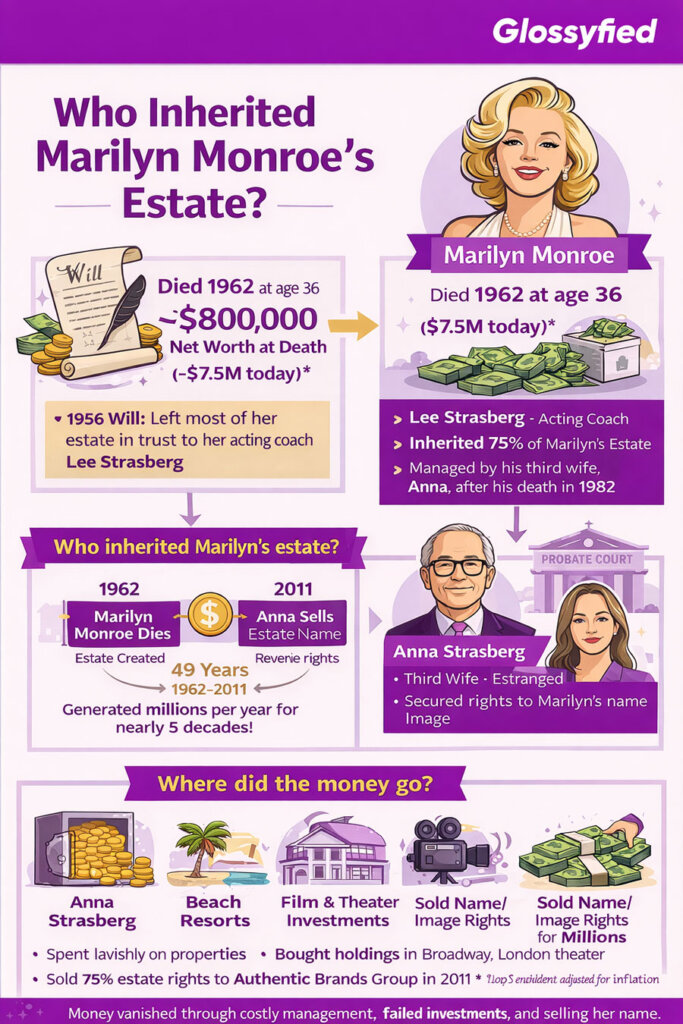
When Marilyn died on August 5, 1962, from a barbiturate overdose, her estate was valued at about $800,000. That sounds like a lot, but she spent freely during her life and had debts.
After paying creditors, income taxes, estate taxes, and funeral costs, only about $370,000 remained. The executor had to carefully manage what was left to pay the cash bequests to her sister, mother, and secretary.
Here’s the thing though. The real value wasn’t in cash. It was in Marilyn Monroe’s image, her name, her likeness. In 1962, the concept of a “posthumous right of publicity” barely existed legally. Nobody knew that Marilyn Monroe’s face would eventually be worth millions.
The executor made a strategic decision that would haunt the estate 50 years later. To save on inheritance taxes, he told tax authorities that Marilyn died as a resident of New York, not California. California had higher taxes. By claiming she was a New Yorker, the estate saved thousands.
Nobody realized that decision would later destroy their ability to control her image.
Lee Strasberg Kept Her Stuff in Storage for 20 Years
Lee Strasberg inherited 75% of the estate and all of Marilyn’s personal belongings. Her clothes, her jewelry, her photos, everything. The will suggested he should distribute them “among my friends, colleagues and those to whom I am devoted.”
He didn’t. He put everything in climate-controlled storage and kept it there for decades.
Strasberg wasn’t a businessman. He was a theater guy. He didn’t aggressively license Marilyn’s image or fight unauthorized merchandise. He just preserved what she’d left him and lived off the modest income from film royalties and occasional licensing deals.
When Dr. Marianne Kris died in 1980, she left her 25% to the Anna Freud Centre in London, a child psychoanalysis research facility. So now a quarter of every dollar generated by Marilyn’s image went to fund therapy research in England. They became silent partners in the estate.
Then in 1982, Lee Strasberg died. And that’s when everything changed.
Lee Left Everything to His Third Wife, Who Marilyn Probably Never Met
Lee Strasberg’s will left his entire estate, including his 75% of Marilyn Monroe’s estate, to his third wife Anna Strasberg. Anna was born Anna Mizrahi in Venezuela. She married Lee in 1967, five years after Marilyn died.
Anna Strasberg had arguably never even met Marilyn Monroe. They definitely had no relationship. And now she controlled the legacy of one of Hollywood’s biggest stars.
This is called the “stranger beneficiary” problem. Marilyn left her estate to Lee Strasberg to take care of him. She probably never imagined he’d remarry and leave it all to someone she didn’t know. If she’d used a trust like Michael Jackson did, she could have given Lee income for life but specified where the estate went after he died.
Anna Strasberg was nothing like Lee. She saw the estate as a business opportunity.
Anna Turned Marilyn Into a Licensing Empire
Anna Strasberg immediately professionalized the estate. She created Marilyn Monroe LLC, hired CMG Worldwide (an aggressive licensing agency that represents dead celebrities), and started putting Marilyn’s image on everything.
T-shirts, posters, slot machines, perfumes, luxury endorsements. Between 1996 and 2000 alone, Anna generated over $7.5 million in licensing revenue. She sued anyone using Marilyn’s image without permission, building legal precedents around celebrity publicity rights.
The estate became known for being litigious. They went after photographers, merchandise makers, anyone. Similar to how estates like James Brown’s or Tupac’s had to fight over royalty control, Anna was building a legal fortress around Marilyn’s brand.
The 1999 Auction: Anna Sold Marilyn’s Belongings for $13.4 Million
In 1999, Anna Strasberg made the decision that defined her tenure. She sold off everything Lee had kept in storage for 37 years. Christie’s held an auction called “The Personal Property of Marilyn Monroe.”
The inventory was insane. Marilyn’s driver’s license. Her makeup case. Her costumes. Her personal photographs. Everything.
The star of the show was the sheer nude Jean Louis gown Marilyn wore when she sang “Happy Birthday, Mr. President” to JFK in 1962. It sold for $1.26 million, a record at the time. (It later resold in 2016 for $4.8 million.)
Singer Mariah Carey bought Marilyn’s white baby grand piano for over $600,000. The total auction brought in over $13.4 million.
Fans and historians were furious. Anna Strasberg, a woman who never knew Marilyn, was selling off the intimate belongings of a Hollywood icon for profit. Critics said the items should have been in a museum or distributed to Marilyn’s friends like the will originally suggested.
Anna defended it as smart asset management. And financially, she was right. The auction was a massive success. Managing celebrity estates with valuable personal items is always controversial, as families discovered with Robin Williams’ bicycle collection or Hugh Hefner’s memorabilia.
The Estate Lost a Huge Legal Battle Over Whether Marilyn Was From New York or California
While Anna was building the licensing empire, she hit a massive legal problem. Photographers who had taken pictures of Marilyn started selling products using those photos. The estate sued them.
The photographers’ defense: California’s “right of publicity” law didn’t apply to Marilyn because she wasn’t a California resident when she died. And they had proof.
Remember how the executor claimed Marilyn was a New York resident in 1962 to avoid California taxes? The photographers dug up those old tax filings. Court documents. Affidavits. All saying Marilyn died as a New Yorker.
Here’s the problem. California has strong posthumous publicity rights laws. New York doesn’t. If Marilyn was a New Yorker, the estate had no exclusive right to her image under California law.
The estate tried to argue she was actually a California resident. They even lobbied for California to pass new laws (Senate Bill 771 in 2007) to protect dead celebrities’ image rights retroactively.
In 2012, the Ninth Circuit Court of Appeals shut them down. The court used a doctrine called “judicial estoppel” – you can’t claim one thing in court to save taxes in 1962, then claim the opposite in court 50 years later to make money.
The estate lost. Marilyn Monroe was legally a New York resident. The estate had no exclusive publicity rights in California. The tax savings of maybe $50,000 in 1962 cost them potentially hundreds of millions in lost licensing control.
It was a catastrophic legal defeat. But by then, Anna was already planning her exit strategy.
In 2011, Anna Sold the Estate to a Corporation for $30-50 Million
In January 2011, Anna Strasberg sold the majority of the estate to Authentic Brands Group (ABG), a brand management company. The deal was structured as a joint venture with ABG and a company called NECA.
The purchase price was estimated between $30 and $50 million for the intellectual property rights. Anna initially kept about 20% as a minority partner, but ABG eventually bought her out completely. The Anna Freud Centre also sold their 25% stake, ending their involvement after decades.
By 2014-2015, ABG owned 100% of the Marilyn Monroe estate. Just like Whitney Houston’s estate and Prince’s estate partnered with Primary Wave, Marilyn Monroe’s legacy was now fully corporate.
ABG is run by Jamie Salter, a Canadian businessman who pioneered “dead celebrity” brand management. They also manage Elvis Presley, Shaquille O’Neal, and Reebok. To them, Marilyn Monroe isn’t a person. She’s a portfolio asset.
ABG Transformed Marilyn Into a $10 Million-a-Year Luxury Brand
When ABG took over, they completely changed the strategy. Anna’s approach was volume – put Marilyn on everything. ABG went luxury.
They canceled hundreds of licensing deals for cheap souvenirs and focused on high-end partnerships. Marilyn became the face of Chanel No. 5 in a major campaign (using her famous 1952 quote about only wearing Chanel to bed). They partnered with Dolce & Gabbana and luxury jewelry lines.
ABG invested in AI and CGI to create a “Virtual Marilyn” for new media. They grew her social media following to 16 million, with a huge portion aged 18-34. They kept her relevant to people born decades after she died.
The results speak for themselves. In 2023, Marilyn Monroe was ranked #13 on Forbes’ list of highest-paid dead celebrities, generating about $10 million annually. Global retail sales of Monroe-branded products hit $80 million+.
Managing intellectual property posthumously is complicated, as estates controlling valuable brands like Agatha Christie’s, Dr. Seuss’, and Frank Sinatra’s have learned. ABG professionalized it completely.
The Bottom Line on Marilyn Monroe’s Inheritance
Marilyn Monroe left her estate to Lee Strasberg (75%) and Dr. Marianne Kris (25%) in her 1961 will. Her family got small cash payments but nothing from the ongoing royalties or image rights.
When Lee Strasberg died in 1982, he left his entire share to his third wife Anna, who Marilyn probably never met. Dr. Kris had already died in 1980 and left her share to the Anna Freud Centre in London.
Anna Strasberg controlled 75% of the estate for 30 years. She professionalized the licensing, sued unauthorized users, and in 1999 held a famous auction selling off Marilyn’s personal belongings for $13.4 million. The “Happy Birthday Mr. President” dress alone sold for $1.26 million.
In 2011, Anna sold the estate to Authentic Brands Group for an estimated $30-50 million. ABG eventually bought out all the other stakeholders (NECA and the Anna Freud Centre) and now owns 100% of the Marilyn Monroe brand.
Today, ABG manages Marilyn Monroe as a luxury brand generating about $10 million annually and $80+ million in global retail sales. She’s a wholly-owned subsidiary of a corporation, managed alongside Elvis Presley and athletic brands.
The estate’s biggest legal disaster was the “tax trap.” By claiming Marilyn was a New York resident in 1962 to save on taxes, they destroyed their ability to claim California publicity rights 50 years later.
The 2012 court ruling found them guilty of judicial estoppel – you can’t claim opposite things in different lawsuits. The short-term tax savings cost them potentially hundreds of millions in licensing control.
Marilyn’s estate went from $370,000 in net value (after debts and taxes in 1962) to a modern brand worth tens of millions generating $10 million+ annually. But the primary beneficiary for most of that journey was Anna Strasberg, a stranger to Marilyn who sold everything and cashed out.
Compared to estates like Johnny Cash’s that stayed in family hands, or Michael Jackson’s where the kids are still supposed to inherit eventually, Marilyn Monroe’s legacy ended up completely divorced from her biological family.
The “stranger beneficiary” problem is what happens when you don’t use trusts. If Marilyn had structured things like Steve Jobs or Robin Williams, she could have given Lee Strasberg income for life while ensuring the estate went somewhere she actually wanted after he died.
Instead, her most iconic belongings were auctioned off by someone she never knew, and her image rights are now managed by a corporation that also owns the Reebok brand.
Marilyn Monroe the person has been completely transformed into Marilyn Monroe the product.
The estate works brilliantly as a business. ABG has elevated the brand, protected it legally (working around the publicity rights loss by focusing on federal trademarks), and made it relevant to new generations. From a pure asset management perspective, it’s a success story.
But from a human perspective, it’s kind of tragic. One of the most famous women in history left her legacy to people who cared about her. Through marriage and death, it ended up controlled by strangers and eventually sold to a faceless corporation.
Her family got almost nothing. Her wishes about distributing her belongings to friends were ignored for 37 years, then everything was auctioned off.
Like James Brown who wanted his estate to fund scholarships for poor kids, or Prince who fought his whole life for artistic control, Marilyn Monroe had specific ideas about her legacy.
Unlike them, she used a simple will instead of sophisticated trusts, and the consequences played out over 60 years.
The lesson for estate planning: if you’re famous, wealthy, or both, don’t just write a will. Use trusts. Be specific about what happens after your primary beneficiary dies.
Consider that the executor’s decisions today (like claiming a certain state residency for taxes) could have massive consequences 50 years from now.
Marilyn Monroe died in 1962 at age 36. Sixty-plus years later, she’s more valuable than ever. But she’s also more divorced from her actual life and wishes than ever.
The estate is a financial success story.
Whether it honors Marilyn Monroe the person is another question entirely.